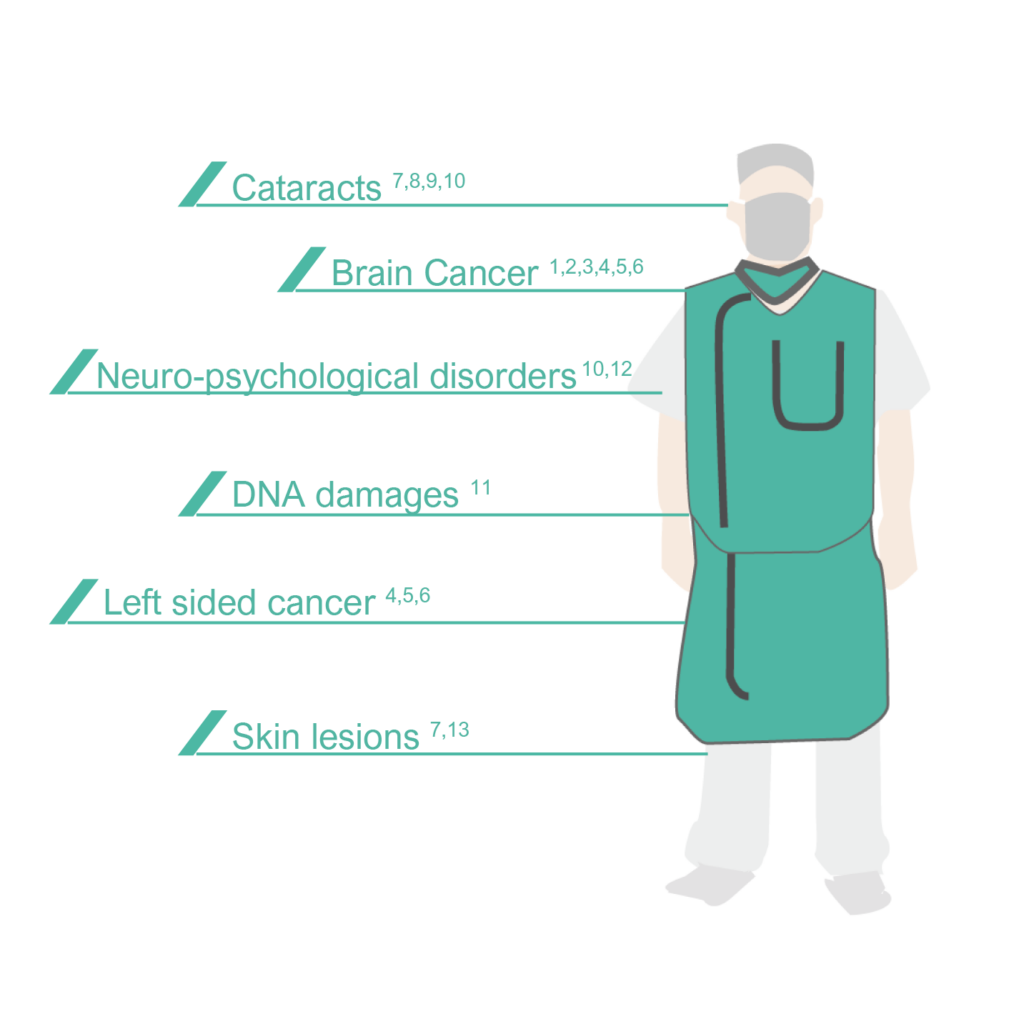
Interventionalists in the cathlab are exposed to 3 differents types of risks due to radiation exposure:
DETERMINISTIC
Health effects, which are directly related to the absorbed radiation dose and the severity of the effect increases as the dose increases.For example, burns on the skin related to prolonged exposure to X-rays.
STOCHASTIC
Effect of ionizing radiation on the human body that occurs by chance, usually without a dose threshold. The probability of occurrence of stochastic effects is proportional to the dose, but the severity of the effect is independent of the dose received. It includes genetic effects (genetic mutations), somatic effects (cancer, cataracts) and in utero effects (embryonic malformations).
MUSCULOSKETAL DISORDERS
In 2023, 66%17 of interventionalists suffer from MSD (49%16 in 2014).
66% suffer from muskulosketal disorders in 2023 (vs. 49% in 2014)
21% had taken a leave of absence due to a physical or mental occupational hazard or injury (9,3% in 2014)
80% would plan to work longer if injuries were better prevented or managed, with 20% indicating they believed they would extend their careers by 10 years or more
NOVARAD STUDY DESIGN
World-first comparative study to:
Measure doses for 3 operators at the same time during neurointerventional procedures
In 4 different centers (Bicêtre University Hospital, Nantes University Hospital, Toulouse University Hospital, Besançon University Hospital)
At 7 different anatomic positions (Head, Thyroïd, Chest on lead, chest under lead, Hip under lead, Forearm, Midtibia)
With last-generation operational dosimeters (Mk3, APVL, France)
Clinical results
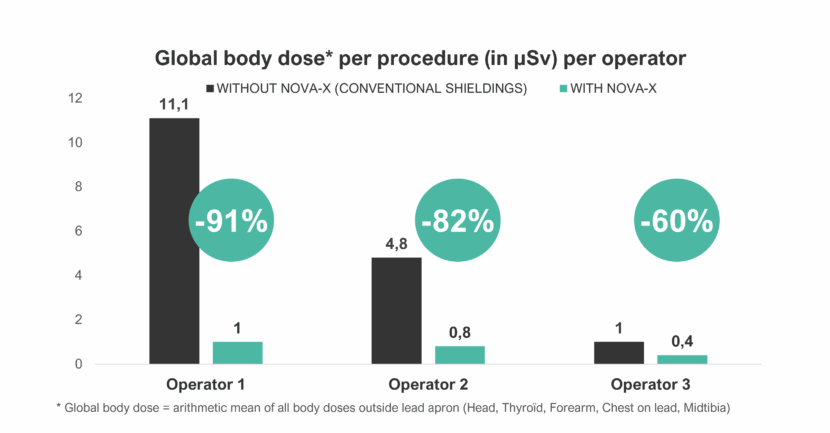
NOVARAD is the world-first multicentric comparative study to evaluate lead-free procedures.
Clinical results
NOVARAD is the world-first multicentric comparative study to evaluate lead-free procedures.
Prevent occupational diseases (cancer, cataract, cognitive disorders, DNA damage and other X-ray-exposure related conditions).
Reduces musculoskeletal disorders (MSD)
66% of interventionalists suffer from MSDs. Transition toward lead-free procedures.
Reduces stress and fatigue
Encourages interventionalists to perform more complex, distal and longer procedures for the patient’s benefit.
Optimises health economics and social outcomes
Reduces sick leave due to occupational hazards. Decreases stress and fatigue among cath-lab staff. Promotes engagement of women in interventional careers.
Dr. Franziska Dorn
Director of Neurointervention Unit
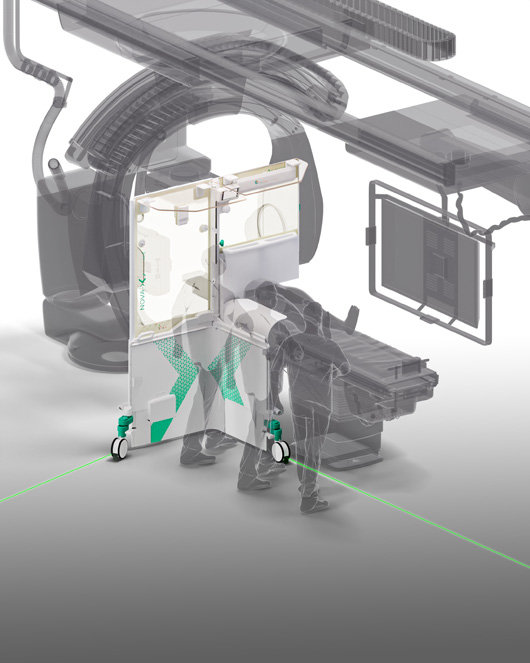
Our team in the angio suite no longer has to worry about their own radiation exposure – no more heavy lead aprons, no compromise on precision – instead a physical protective barrier with real-time dose monitoring. A safer workplace for our team ultimately means better care for our patients!
Pr. Christophe Cognard
Head of Neuro Dpt.
This cabin is like a wall between the X-ray machine and the operator, and finally, when you look at the results, you have 91% of dose reduction for the body, you can remove your lead apron, but above all, the field of X-rays is much reduced […] If you do 300 procedures per year with the cabin, which is a lot for a neuroradiologist, you will receive 0.4 mSv which is much below the minimal dose for the common population […] Finally, with the cabin you are more or less like anyone
Pr. Romain Bourcier
Interventional Neuroradiologist
I would say that Nova-X® helped me to come back to work in good conditions, drastically reducing back pain. I discovered a new way of working which brings a lot of benefits beyond the comfort of no wearing lead apron.
Allow all cookies
Continue without accepting
Cathpax respects your privacy
Cathpax and its partners use cookies or similar technologies and process personal data that can be crossed with information provided as part of our services for the following purposes: improving your user experience, carrying out audience statistics and studies to improve our offers, offer you services tailored to your interests, display targeted advertisements on our site or those of partners, measure the performance of these advertisements, use precise geolocation data, offer you functionalities relating to networks social, fight against fraud. Some cookies are necessary for the site and our services to work. You can accept, manage your preferences by purpose or continue browsing without accepting.